


Tecnológico de Monterrey is the only university outside the United States that participates in CoLLT, an international network dedicated to studying the transformation of the humanities.
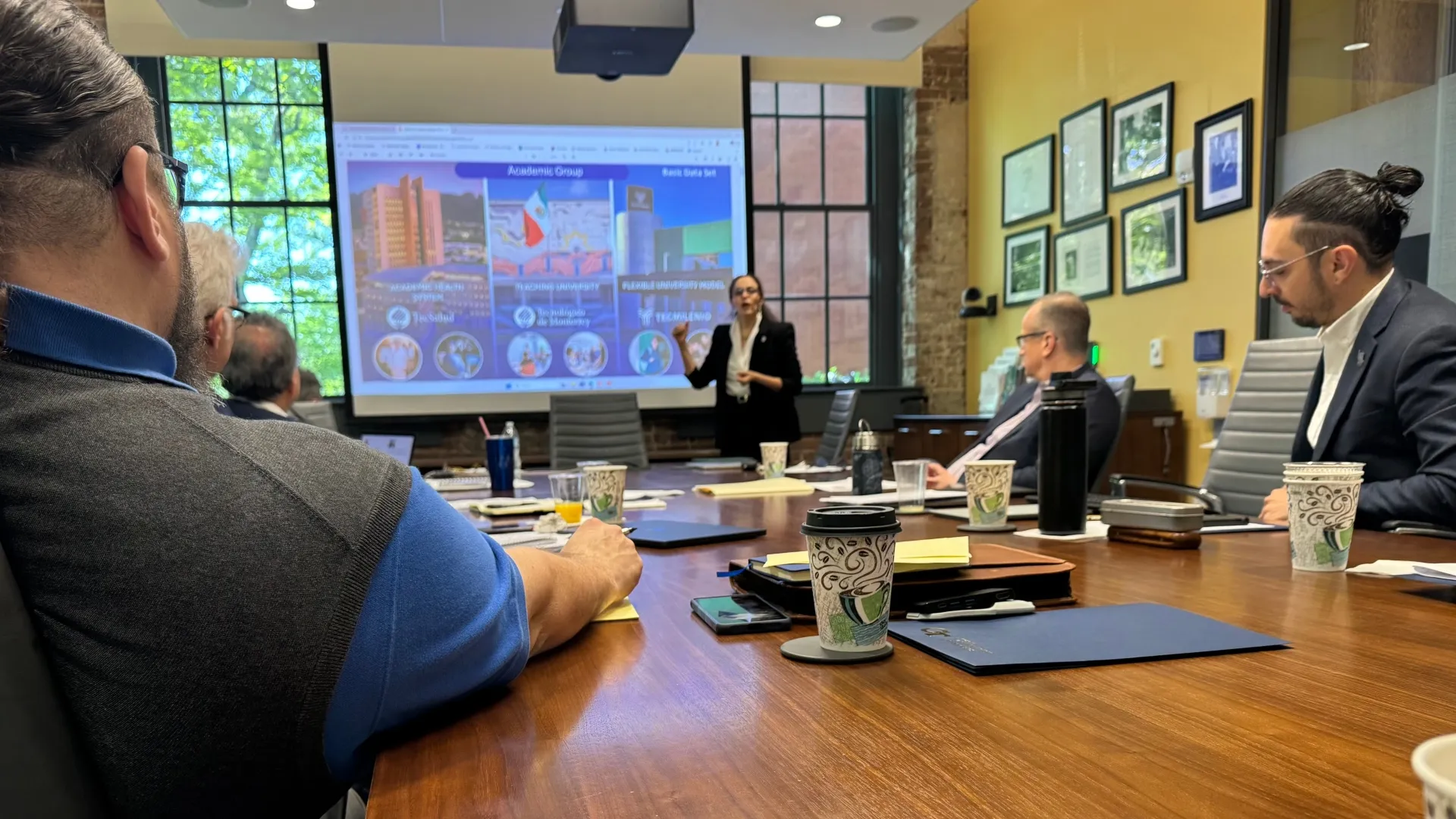
Now that artificial intelligence (AI) and technology are transforming the role of universities, Tec de Monterrey, through its School of Humanities and Education, has joined the Council of Liberal Arts Leaders at Technological Institutions (CoLLT).
CoLLT is a platform where technological universities with a humanities-based curriculum analyze the changesthat artificial intelligence and other technologies are bringing about in higher education.
“We’re trying to identify the role of the humanities in the face of these changes, since we find ourselves in an educational environment that is changing drastically every day,” says Judith Ruiz Godoy, National Dean of the School of Humanities and Education.
Artificial intelligence already writes texts, generates images, reconstructs historical objects, analyzes cultural archives, and participates in creative processes that, until just a few years ago, seemed to be exclusively human.

Humanities schools at international institutions are rethinking their role in light of this transformation. How can we teach, conduct research, and train students when artificial intelligence is changing the way we create knowledge, work, and even interact with one another?
“We’re in the midst of a debate that takes an in-depth look at where humanity is and what it means to be a human being. I think that we’re at a very special moment as a society,” adds Ruiz Godoy.
CoLLT was officially established last May and includes institutions such as the Massachusetts Institute of Technology (MIT), Georgia Tech, Virginia Tech, SUNY Polytechnic Institute, Wentworth Institute of Technology, Missouri University of Science and Technology, and Kettering University.
Tecnológico de Monterrey is the only university outside the United States that participates in CoLLT and collaborates with other institutions in discussions on collaboration between the sciences and the humanities.
“We’re trying to identify the role of the humanities in the face of these changes.” —Judith Ruiz
The hybrid professional: A humanistic and technological profile
The goal of the Council of Liberal Arts Leaders at Technological Institutions is to foster a global discussion on the strategic role of the humanities in STEM (science, technology, engineering, and mathematics) ecosystems.
According to Judith Ruiz, the network brings together humanities departments from international institutions. During its initial meetings, their representatives agreed that one of the main challenges is developing hybrid profiles: researchers, professors, and students capable of moving between disciplinary languages that have traditionally been separate.
For Branko Pérez Restovic, Head of Internationalization at the School of Humanities and Education, this phenomenon is not new but is more urgent today.
“We’ve discussed the need for hybrid profiles in the faculties. That’s our value proposition: to offer a humanistic approach combined with technological tools,” says the professor.
Ruiz Godoy adds that the Tec is rethinking the way it educates its students in order to teach them how to be self-critical.
The dean believes that the fundamental debate is not focused solely on new technologies or new educational models, but on something deeper: what it means to educate people in an era of rapid change.
“We’re at a university, and the educational process involves asking questions about being, not just about doing.”
The humanities at technological universities
According to Ruiz Godoy, the Tec has been committed to Digital Humanities for the past three years, a transdisciplinary field that focuses on ways of interpreting, producing, and sharing information and knowledge.
This initiative opens the door to new forms of creation, research, and teaching. From using artificial intelligence in content production to engaging in ethical reflection on these tools, the school combines technological innovation with critical thinking.
“Digital humanities is a very rich field in which we raise ethical questions about what the use of these tools entails, and we even extend this to the realm of sustainability,” says Ruiz Godoy.
However, this duality does not apply only to humanities students. The dean points out that science and technology students must also develop critical thinking and ethical reflection.
“Our goal is to find humanists who want to talk about technology; we also need people with backgrounds in science and technology who are willing to cross over to the other side to discuss ethics and critical thinking, so that we can deconstruct and decolonize these platforms and identify the biases we have as a society,” she adds.
Humanities research to tackle the impact of AI
In addition to the Digital Humanities program, the Tec has launched an initiative to update its undergraduate curricula by 2026, as well as certification programs, graduate programs, and training courses designed to prepare hybrid professionals.
What’s more, initiatives such as LIFE, Ruta Azul, the Center for the Recognition of Human Dignity, and the Community Service program reinforce students’ humanistic education.
The Tec is also adopting initiatives such as the MIT Human Insight Collaborative (MITHIC), in which humanities specialists participate in technology projects from their earliest stages to integrate ethical, social, and cultural perspectives.
According to the dean, the rationale behind this type of initiative is that no technological advancement can be fully understood without taking into account its cultural, social, and human dimensions.
YOU’LL ALSO WANT TO READ:
Seleccionar notas relacionadas automáticamente
1
Category:
Related stories


