


The Álvarez-Trujillo Lab is developing a technique capable of recreating complex biological structures for applications in tissue engineering, cancer research, and cultured meat
A new form of biofabrication, known as chaotic bioprinting, is being developed in Mexico by the Álvarez-Trujillo Laboratory at Tecnológico de Monterrey.
This technique will make it possible to recreate the internal complexity of living tissue without the process being extremely slow, expensive, or limited in resolution.
Thanks to these types of procedures, the laboratory located at EXPEDITION FEMSA, which is part of the Monterrey Innovation District, has established itself as one of the most renowned in Latin America.
Mario Álvarez and Grissel Trujillo lead this laboratory, which includes more than 50 researchers.
The laboratory and the Innovation District are part of a research ecosystem that positions the Monterrey campus as a leading venue for events such as the 2026 International Conference on Biofabrication.

This annual event will be held in Latin America for the first time, with the Monterrey campus hosting the conference, which is expected to welcome around 400 researchers, professors, students, and entrepreneurs from around the world.
It will take place from November 2 to 6 and is organized by the International Society for Biofabrication (ISBF), which since 2006 has established itself as the most important global forum for bioprinting and biofabrication.
Tissues, cancer, and cultured meat
The Álvarez-Trujillo Laboratory focuses on two main areas of tissue research: muscle and tumor tissue, and has begun to explore others.
“The field of muscle tissue engineering includes the creation of meat,” Álvarez said.
“We work on the architecture, on meat fabrication, which sounds strange, but it’s humane. One model we use is mouse tissue. We create mouse tissue in the lab. It’s a model that’s widely used around the world,” he explained.
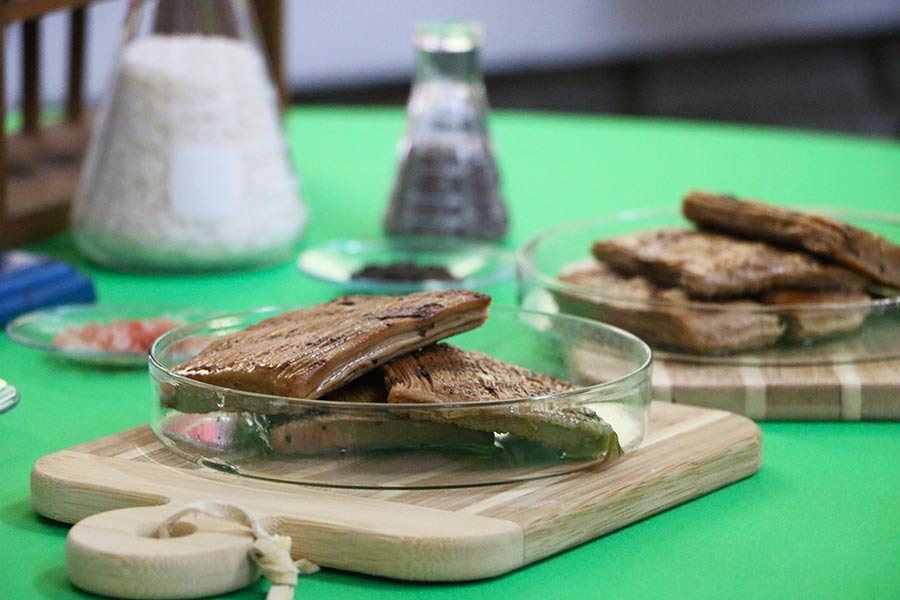
This line of research led to the creation of Forma Foods, a company that produces meat by culturing animal muscle cells.
"The great thing is that when you say ‘chaotic bioprinting,’ you think of Mexico and Tec de Monterrey. It’s something that was created here.” – Grissel Trujillo.
In the case of cancer research, efforts are focused on developing in vitro cancer models to test drugs and, ultimately, advance precision or personalized medicine.
This has led to research such as that conducted by Carlos Ceballos, who co-developed a patented bioprinting technology in the laboratory that is capable of arranging living cells with micrometer-level precision.
Using this platform, he produced three types of cancerous tissue, which led to him winning the Rómulo Garza Award.
Chaotic bioprinting
The hallmark of the laboratory is chaotic bioprinting, a technique developed by the doctors that has been used in tissue development.
“We realized that chaotic bioprinting is great. There are few techniques that are as effective at creating structure.
“We say that it creates complexity through simplicity, whereas many other engineering techniques do exactly the opposite. They use very complex processes to achieve very simple results. We do the opposite. We use a very simple system to achieve complex results,” said Trujillo.
This technique uses chaotic flows to organize living cells and materials into complex structures similar to those found in real biological tissues.
“We can now make skin, very flat items, or tiny, very thin pieces of tissue to create thicker tissues.” – Mario Álvarez
This makes it possible to create tissues with porous microarchitectures capable of transporting nutrients and oxygen, one of the main challenges in tissue engineering and the creation of artificial organs.
“Chaotic bioprinting is already making waves around the world. There have already been congressional hearings devoted entirely to chaotic bioprinting.
“It’s also beginning to be adopted by other research groups. And the great thing is that when you say ‘chaotic bioprinting,’ you think of Mexico and Tec de Monterrey. It’s something that was created here and has already established a very strong presence in the community,” said Trujillo.
A technique already gaining traction around the world
It was in the field of biofabrication that this technique found its place, after it was presented at a conference in 2019, Trujillo recalled.
“People understood it, and it was really wonderful for us because we hadn’t felt that anyone truly understood and appreciated it for its value to the community.”
“So that’s where we found our tribe, and we said, ‘We belong here. We’re going to stick with it and keep contributing,’” she said.
This technique has gained prominence because it is easy to scale.
“One of the major problems or challenges in tissue engineering is scaling up. We can now make skin, very flat items, or tiny, thin pieces of tissue to create thicker tissues.
“The goal is to create a functional piece of kidney and a large tumor on which we can test drugs on a clinically relevant scale,” Álvarez said.
“We realized that a chaotic bioprinting is great. There are few techniques that are as effective at creating structure.” – Grissel Trujillo
To produce a piece of edible cultured meat, it is necessary to keep alive tissue that is one or two centimeters thick, and this is achieved by creating a porosity similar to that found in living bodies, which have capillaries that carry nutrients, blood, and oxygen to every cubic centimeter.
“How do we create that porosity in a material? The technique we’ve developed is one of the things it can do. We can create tissues with a microstructure in which that microarchitecture or microstructure is porous.
“It allows you to nourish and sustain a tissue that is thicker than conventional tissue for a long time,” explained Álvarez.
Positioning themselves in biofabrication
Thanks to this research, the laboratory led by Mario Álvarez and Grissel Trujillo has established itself as one of the most prominent groups in biofabrication in Latin America.
The researchers noted that there are currently specialized centers in Latin America, primarily in countries such as Brazil, Colombia, Argentina, Costa Rica, and Mexico.
This has enabled the Tec group to distinguish itself through the development of its own technology and international collaborations.
According to the team, chaotic bioprinting is already beginning to be associated within the scientific community with Mexico and Tec de Monterrey, becoming one of the laboratory’s hallmarks on the international stage.
In addition to scientific advances, the researchers believe that the growth of biofabrication in Mexico could create new opportunities for students, startups, and technology projects related to health, food, and sustainability.
YOU MAY ALSO BE INTERESTED IN READING:
Seleccionar notas relacionadas automáticamente
1
Category:
Related stories


